Today was red beans and rice again for lunch with a granola bar for breakfast. This evening I noticed that I am running low on red beans and rice so I decided to make some chicken fried rice. 2 lbs of rice ($.49), 2 chicken breasts ($2.20), 4 eggs ($.40) 1/2 lb of vegetables ($.56) 4 oz of soy sauce (.70) yielded 6 gladware containers filled with fried rice which equals about $.725 per container. With the red beans and rice I usually got 2 meals out of each container so I am looking at about .3625 per meal. I am sure it will be more than that because the rice actually tasted REALLY good when I was making it. I am actually looking forward to eating these meals.

Uzbekistan is an "doubly landlocked country" I had no idea what this was until I read about it. Basically it means that it borders only countries who are also land locked. This means that you have to cross two international borders in order to reach a sea coastline. Uzbekistan is in central Asia. "Stan" means "land of" in Persian. So "Afghanistan" is "Land of the Afghanis" and "Pakistan" is "land of the Pakis" so "Uzbekistan" means Land of the Uzbeks. Formerly it was a part of the Soviet Union and gained its independence upon the break up of the USSR, currently it reigns as one of the poorest nations in central Asia.
Its economy is based on commodities such as cotton, gold, and natural gas with little or no added value to the product. Many of the people are farmers/herdsmen who make their living off of the land. Many are small scale subsistence operations. This keeps the economy of Uzbekistan from growing at a sustained rate.
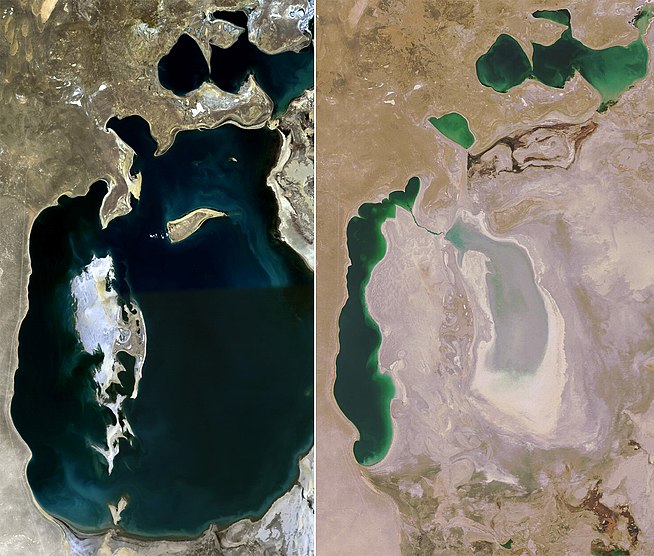
The main claim to "fame" for the Uzbek's is the legacy that they have from Soviet mismanagement of the Aral Sea. The Aral sea used to be the fourth largest inland lake in the world behind the Caspian sea, Michigan/Huron and Superior, but the Soviets diverted much of the water for use in agricultural and the lake has dried up often leaving boats abandoned, high and dry

The picture below shows the shrinking of the Aral sea from 1989 to 2008.
These environmental issues are only part of the problem. Government controls have kept the economy from advancing to a market economy. These heavy handed tactics have also been used in suppressing the public from time to time during periods of civil unrest. The union of these environmental, political and economic policies have conspired to keep Uzbekistan from improving its standing among the nations as a regional and economic power. If anything, history tells us that there is not much improvement forecast for the future.

No comments:
Post a Comment