Wednesday, March 9, 2011

#10 - Namibia

Today was an interesting day.  Work was long and I got home just in time to see my son go to bed.  I just hate those kind of days.  It is just so depressing to not be able to spend time with my son...which got me thinking.  I wonder how hard or how long many of these people who live in these areas work to earn the meager amount that they get.  The short answer, of course, is as long as it takes and sometimes I am sure that is different than others.  I do know that it can be extremely frustrating living on the edge where one bad day can push you into a life or death choice.  What happens when a child gets injured? Or what happens when the primary breadwinner is injured.  The choices that some of these families are confronted with are so depressing that we in our insulated American lives refuse to even go there.  We dismiss it as something that is thousands of miles away and beyond our control so why worry about it or even give it any thought.  I hope we can move beyond this and consider what we might be able to do for those less fortunate, like those in Namibia...

Namibia is located on the west coast of southern Africa.  It is a land that is sparsely populated and had parts of two deserts and highland plateau within its borders.  During Colonialism it was a German colony and after WWI it was a colony of South Africa.


Unlike most of the other troubled African nations, Namibia has had a strong and prosperous central government that is highly democratic.  It has engaged in racial reconciliation and the transition from white minority rule and the policy of apartheid to black majority rule has been impressive.

Namibia's economy is highly dependent upon South Africa and relies much upon mining, manufacturing, agriculture and eco-tourism.  Much of the economy though, is informal and undocumented.  In fact these two economies are often seen in the extreme with some living in the cities with an urban lifestyle and others in the wilderness living on a cashless barter and trade economy.  While education is a priority and compulsory between the ages of 6 and 16, the health care situation is problematic.  The Aids epidemic in Namibia is huge.  Nearly 15% of the population is infected and this has left a huge population of orphans that the state has to contend with.

These are the challenges of Namibia, but because of its stable government and the focus on education, there is hope for the people of this nation.  I just hope that they are able to continue in a positive direction.

Tuesday, March 8, 2011

#9 - Uzbekistan

Today was red beans and rice again for lunch with a granola bar for breakfast.  This evening I noticed that I am running low on red beans and rice so I decided to make some chicken fried rice.  2 lbs of rice ($.49), 2 chicken breasts ($2.20),  4 eggs ($.40) 1/2 lb of vegetables ($.56) 4 oz of soy sauce (.70) yielded 6 gladware containers filled with fried rice which equals about $.725 per container.  With the red beans and rice I usually got 2 meals out of each container so I am looking at about .3625 per meal.  I am sure it will be more than that because the rice actually tasted REALLY good when I was making it.  I am actually looking forward to eating these meals.


Uzbekistan is an "doubly landlocked country"  I had no idea what this was until I read about it.  Basically it means that it borders only countries who are also land locked.  This means that you have to cross two international borders in order to reach a sea coastline.  Uzbekistan is in central Asia.  "Stan" means "land of" in Persian.  So "Afghanistan" is "Land of the Afghanis" and "Pakistan" is "land of the Pakis" so "Uzbekistan" means Land of the Uzbeks.  Formerly it was a part of the Soviet Union and gained its independence upon the break up of the USSR, currently it reigns as one of the poorest nations in central Asia.

Its economy is based on commodities such as cotton, gold, and natural gas with little or no added value to the product.  Many of the people are farmers/herdsmen who make their living off of the land.  Many are small scale subsistence operations.  This keeps the economy of Uzbekistan from growing at a sustained rate.

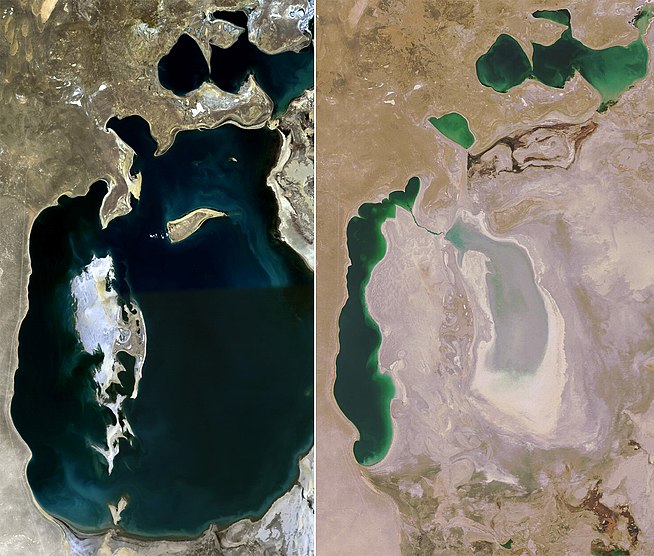
The main claim to "fame" for the Uzbek's is the legacy that they have from Soviet mismanagement of the Aral Sea.  The Aral sea used to be the fourth largest inland lake in the world behind the Caspian sea, Michigan/Huron and Superior, but the Soviets diverted much of the water for use in agricultural and the lake has dried up often leaving boats abandoned, high and dry


The picture below shows the shrinking of the Aral sea from 1989 to 2008.


These environmental issues are only part of the problem.  Government controls have kept the economy from advancing to a market economy.  These heavy handed tactics have also been used in suppressing the public from time to time during periods of civil unrest.  The union of these environmental, political and economic policies have conspired to keep Uzbekistan from improving its standing among the nations as a regional and economic power.  If anything, history tells us that there is not much improvement forecast for the future.


Monday, March 7, 2011

#8 - Guinea

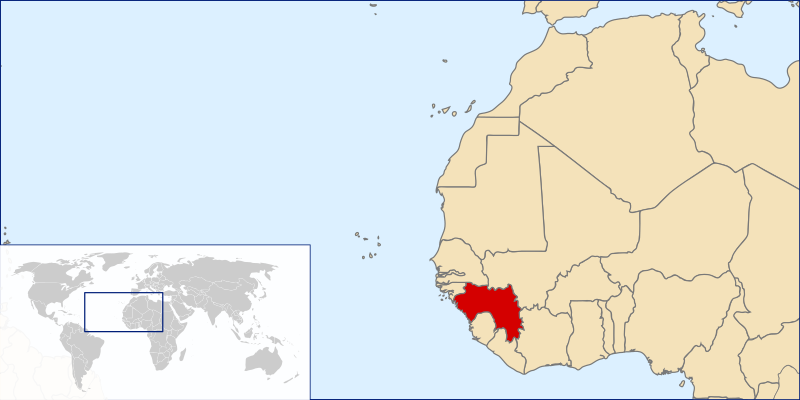
AS mentioned earlier, today I stayed home with my son.  This morning I ate a handful of dry Cheerios and the same for lunch.  Dinner was a half serving of red beans and rice with seasoned chicken.  Needless to say, lots of things are starting to look real good right now. Guinea is the country for Tuesday March 8th.  Tuesday marks the beginning of only the second week of my bucktwentyfive month.  Needless to say I am wondering if I have the stamina to make it through the week, let alone the month.

Guinea is a country on the western coast of Africa.  As I read about Guinea I wondered if I was reading the same stories about so many other nations in Africa.  The original tribal society obliterated by French Colonialism only to be thrust upon the world stage in the 60s and left to the powers that be.  Despots followed by Coup's followed by staggering attempts at Republicanism...


Guinea is rich in natural resources but it is yet to be seen if they can enrich the people that live in that country. Too often these resources are taken by the powerful and not shared with the people in any meaningful form.  Healthcare is low and literacy is among the lowest in the world with an estimated 30% of adults literate.  This lack of education condemns the majority of the population into a life of back breaking poverty that they are unable to rise above.  

The newly elected President said he will review the mining contracts and other such issues, but improving the infrastructure and education should be the primary goal.  Without it there is little hope for the people of Guinea.

#7 - Central African Republic

Today I had to stay home with my son.  I did get a lot done but I was unable to post to this blog.  This is the one that should have been posted this morning.

The Central African Republic is listed as having 62.55 of its population living on a buck twenty five or less.  While this is likely to be close, it is impossible to truly get an accurate measurement.  The reason for this is that much of the economy is done on the black market. For instance Diamonds make up 40-55% of its export revenue but between 30-50% of the diamonds mined in the Central African Republic are sold on the black market and smuggled out of the country illegally.

But while the real GDP of the country is likely much better, most of that money will probably not be given to those working on subsistence farms raising cassava, the main food stuff of the country.  Ever since its independence from France, the Central African Republic has followed a course similar to those of its neighbors filled with coup d'etat's and dictators proclaiming themselves "President for Life".

Recently steps to legitimize the government process through elections has been hampered and postponed.  How soon can this country return to the path of a legitimate national government cannot be guessed.  Until it does, it is likely that the main resources of the nation will continue to be diverted to the pockets of warlords and power hungry regimes.

Saturday, March 5, 2011

#6 - Nigeria

Saturday I was away from home and only packed a few granola bars.  I ate when I got  back home today but I wasn't very hungry in spite of having little to eat today.  I think part of it is because I am not feeling the best and am a little under the weather.  I hope that improves soon but if it doesn't I guess it will be easier to live on a buck twenty five...

Nigeria is country on the west coast of Africa and gets its name from the N i g e r River that runs through it.  Nigeria is also the seventh most populous country in the world.  With such a huge population one would think that it would be well on its way to economic prosperity but 64.4% of its population lives on a buck twenty five or less a day.


The root of this problem lay in the oil rich region of the N i g e r delta.  This region has been the key to controlling the government ever since it was nationalized.  It makes up a substantial portion of the nations economy and while it makes the government rich, it does nothing to help those who are poor in the country.  Basic infrastructure is poor, health care is poor with a life expectancy of 47 years and an infant mortality rate of 97.1 per 1000 live births.

Political instability has been along standing problem in Nigeria.  Since 1960 when it gained its independence from Britain, it has endured several coup d'etat's and military rule.  Recent political history has seen a return to a republican form of government but corruption is still a big problem.

While the economy of Nigeria has a long way to go, it has been improving recently and Nigeria is among the fastest growing economies.  As the first African nation to pay off its debt, it has the ability to spend a larger percentage of its income on debt relief programs.  As long as the government is stable, this is something likely to happen, but stability has not always found a home in Nigeria.


Friday, March 4, 2011

#5 - N i g e r

Today was a very stressful day at work.  We had a lock-down at school.  Nothing serious came of it but it was very tense for a few hours.  It happened in the two periods leading up to lunch so our lunch period was displaced and I did not get to eat my lunch so I just brought it home.  

Issues of violence are common themes in the countries with rampant poverty.  The question I have is why?  Why do these countries seem to be the ones most plagued by violence and economic disruption.  Could it be that there are greater forces at work to ensure some sort of dis-equilibration for their own purposes?  Especially when we consider the main export of our next country.


Today we have N i g e r.  N i g e r  is a land locked country in the Saharan region of Africa that struggles with 65.9% of its population living under back breaking poverty.  Near constant drought, political instability and lack of developed infrastructure continue to hinder the ability of the common people of N i g e r  from rising above their often meager existence. 

Since its Independence in 1960, N i g e r  has endured four coup d'etat's resulting in five different Republics.  The military has often played a huge role in the political instability with much of the countries wealth coming from the export of uranium.  Aside from a few urban areas and mining areas, the main export of the country is cattle and other animal products.  Much of the country lives in poverty.

In N i g e r , the infant mortality rate is 248 per 1000 live births with nearly 8 percent of the population languishing in forced slavery.  Those who exist in this state do so with little to hope for.  It is disturbing that Slavery still exists in this world and it is even more deeply disturbing that it continues to take place in Africa. This is just another reminder of the scars of European Colonialism.

Please keep the people of N i g e r in your prayers.

Thursday, March 3, 2011

#4 - Chad

Yesterday I got up in time to fast for the day because of a physical exam that I had scheduled at 5:30.  I spent the day starving until after 5:30 when I had to go to Kroger's to buy the mixes for a bazillion cupcakes I had committed to making that night.  Currently It is 1:05 AM and I am finished making cupcakes and I can honestly say that, outside of licking a bit of icing off of my fingers,t here was only one casualty...a vanilla cupcake took a nosedive off the counter  and onto the Kitchen floor...sooo, yeah..I ate it.  Five second rule right?

An-e-way...I finished off yesterdays red beans and rice with chicken this evening in between rounds of cupcake frosting.  Tomorrow I get a reprieve of sorts.  The coworkers at my job provide a breakfast each Friday...one of the highlights of my week each week will be free food that is available to me to gorge myself on.  So I am caught in a quandary of sorts.  The food id obviously no cost to me, but to remain true to the spirit of the challenge should I just forgo the Friday freebies and focus on my own food?  Let me know what you think in the comment section below...I will let you know what I chose to do later on tonight.  For now, Here is Chad...the country, not the person.


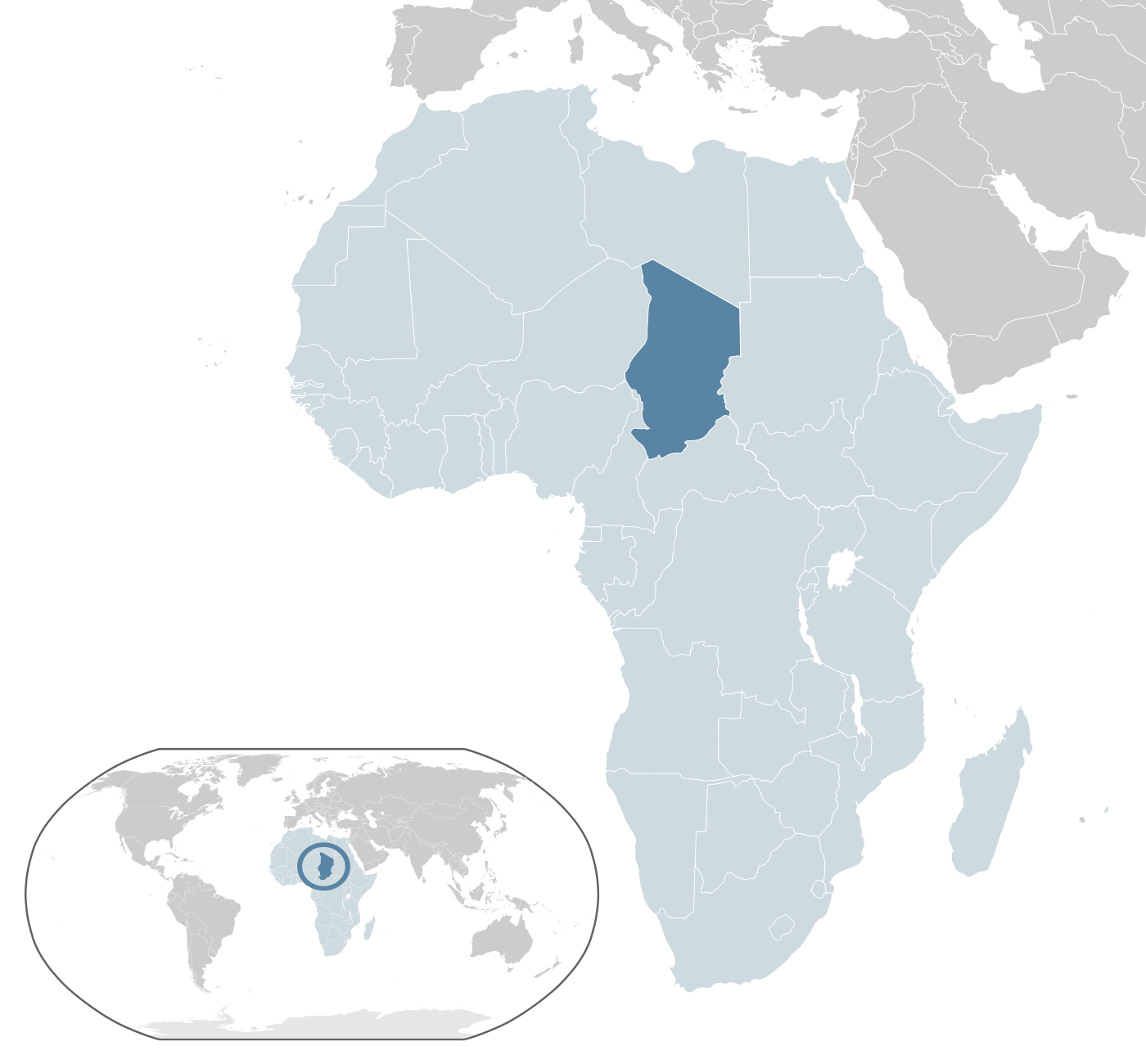
The Republic of Chad is a landlocked country in Central Africa.  61.95 of the people in Chad exist on a buck twenty five or less.  This is due to many factors, some environmental and some political.

The political reasons are many and varied.  Since its independence in 1960, it has had to endure civil war, threats from Lybia and other neighbors and even when a regime manages to bring stability, it does to at the cost of dictatorial power.  Currently ethnic violence similar to that which has plagued the Darfur region of Sudan is flaring up in the eastern provinces.  That has been mixed with various rebel attempts to capture the capitol leaving much of Chad in power vacuum.  In this environment, trying to improve your standard of living is like trying to build a house in a hurricane.

The environmental factors that have contributed to the problems in Chad center around the misuse of water during the 1960s and 70s that led to the shrinking of Lake Chad.  Lake Chad, when it was first surveyed  amazed early Europeans with its immense size.  It was generally shallow but it was teeming with fish and it was a freshwater lake.  It began as a lake that once covered over 400,000 square km in its ancient history. but by the 1960s it had shrunk to only 26,000 square km.  Currently is covers only 1350 square km.  The pictures below show the progression of Lake Chad from 1973-2001
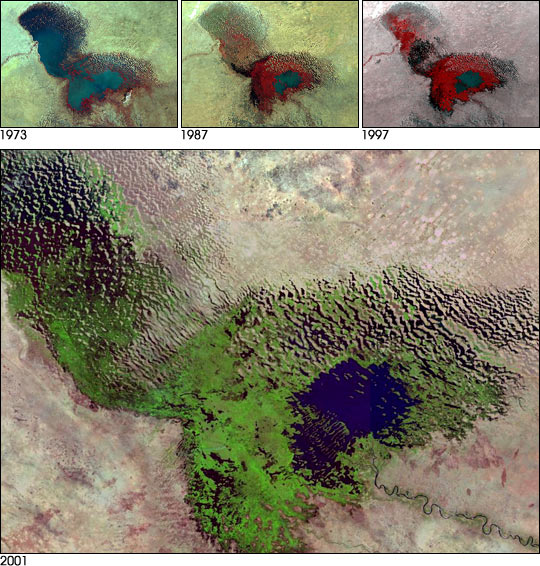


This shortage of water has caused violence and conflict among those that dwell along the lake shore.  This conflict over the water and the resources of the lake is a constant drain on the economy of the region which continually drags down the ability of the people to provide for their families.  These are the everyday challenges of the people of Chad.  Please pray that the problems of nearby Sudan do not spill over into this country that faces so many challenges already.

#3 - Madagascar

I have realized something about this blog.  I am only able to get on at night and since this blog is suppose to highlight a country a day, it seems kind of silly to post that country at the end of the day.  So tonight you get an extra special to-for-the-price of one.  Madagascar is the country that was suppose to be for Thursday.  So I am posting it now and I hope you enjoy, but I will also post tomorrows blog tonight and will post the next days country the night before.  I think this will work better.  So with no further adieu, here is the former French colony of Madagascar.

Everyone knows Madagascar, it was a great movie right?  Well, more than a movie, Madagascar is an island to the east of the southern tip of Africa.  It was uninhabited until sometime between 200 BC and 500 AD when it was colonized both by Bantu migrants from Africa and early Polynesian migrants on outrigger canoes.  These groups joined to form the Kingdom of Madagascar that remained independent until a war with France forced Madagascar to become a colony of France.

The economy of Madagascar is primarily agricultural with coffee and vanilla being the primary exports.  Interestingly, when Coke switched to "New Coke" in the mid 1980s (a recipe that used less vanilla) the economy of Madagascar took a big hit.  But as we all know that downturn was short-lived when Coke switched back to Coke Classic.

Currently the per capita GDP is a meager $393 per person per year.  Much of the money is controlled by the owners of huge coffee and vanilla plantations.  The rest of the country survives on an underfunded education system and a healthcare system that endures a infant mortality rate of 74 per 1000 live births.

In recent years, the political climate has been stable, but that is far different from the many years since its Independence in 1960.  Much of Madagascars political history has been marked by coup d'etats, military regimes and despots posing as republics.  This has given Madagascar a long way to go to improve their economy and the situation of their people.

Wednesday, March 2, 2011

#2 - Mozambique

Today was...interesting. Last night I learned that a physical I had scheduled for tomorrow was a fasting one so tomorrow I have to go 12 hours without eating anything. I guess that helps me keep under a buck twenty five, but it makes my life that much more difficult.  


This morning I was so focused on making sure I remembered my granola bar for breakfast that I forgot to get my lunch...so I had to go without eating today AND I get the privilege of not eating again tomorrow. (Oh Joy!)


So today I age a granola bar for breakfast and when I got home I ate some of my red beans and rice with a seasoned chicken breast that I thawed and cooked up. (cost of chicken $1.17) Half I ate tonight and half I will save for tomorrow.


Mozambique is a country on the southern coast of East Africa just above South Africa. Like most of Africa, Mozambique endured several centuries of colonialism. By the early 1500s, Portugal began building fortified cities and ports on the coastline and began exerting influence over the rest of the territory that would one day become Mozambique.
By 1975, the independence movement was sufficient and the independent country of Mozambique was formed. The national language is Portuguese. The majority of the people are Christian but a sizable portion of the population are Muslim.

Since 2000, Mozambique has been the fastest growing economy in the world but the gap between the rich and the poor has been growing even more. Over 10% of the population between the ages of 19-49 is HIV positive and the infant mortality rate is 100 per 1000 live births. With 74.7% of the population that lives on a buck twenty five or less, the poverty in this nation is crushing and exacerbated by the fact that the growing economy is leaving many behind. In 2005 over one million school age children were not enrolled in schools, mostly in the poor, rural areas, and many teachers were still unqualified to teach. With these severe challenges and lack of basic needs, the future for the poor in Mozambique does not look to improve much in the coming years.

Tuesday, March 1, 2011

#1 - Liberia

Today was the first day of my quest.  I started off with a granola bar had half of my rice for lunch and the rest for dinner.  I was hungry quite a lot today.  My rice was...bland and needs more help.  I am seriously thinking of frying up one of my chicken breasts tonight and slicing it up in with the rice.

Today in class we talked about Liberia.  Liberia is a country that is unique in Africa.  Most of its people originated in Africa, spent time as enslaved individuals in the American South as part of the plantation economy, and then, upon achieving their freedom, were "exported" back to Africa in an attempt to answer the free black "problem" in America.  It was a colony for former slaves, but to become that colony, white northern abolitionists had to "displace" the existing tribes, sometimes at the point of a gun.  Liberia became a place of liberty for freed slaves but at the expense of the liberty of others.  That is the problem with racism and slavery, its crooked fingers dig deeper into the souls of people and affect more lives than we can see at first.  The ripples of wrongs done echo off into eternity...

With 83.7% of the population living on a buck twenty five or less, Liberia has the dubious honor of having the highest percentage of their population living in bone crushing poverty. Liberia has had a rough history, first as a destination colony for free blacks from the United States, then as an independent country then as a country torn apart by a coup d'etat and two civil wars. Liberia is the only country to have its capitol named after a former US President (James Monroe - Monrovia).  Liberia is located on the western coast of Africa.  

From 1847 to 1980, Liberia plotted its course as a free and independent country. In 1980 however, William Tolbert was deposed in a military led coup d'etat and this began the downward spiral for a country that had already been a poor country. Two civil wars later, a peace movement called Women of Libera Mass Action for Peace led by Lemaah Gbowee and consisting of both Christian and Muslim women forced the head of state into peace talks. The followed the example of the people of Rwanda that choose forgiveness than retribution.  They chose the path of peace regardless of the wrongs done in the past and they forced other to come along.  They staged a sit in around the site of the peace talks, preventing anyone from entering or leaving until the peace had been agreed upon. In the government that was established by these peace talks, they were also key in electing the first African female head of state, President Ellen Johnson Sirleaf. This story is told in the 2008 documentary "Pray the Devil back to @#!*% "

This is how the ripples of evil are expunged.  They melt like snow on a warm day when confronted with the healing work of grace and forgiveness.  While the current situation is bleak, the power of the people to effect real and lasting change has imbibed the country with a sense of new hope. While Liberia has a long way to go, at least it seems to be pointed in the right direction.